
The Request Beneath the Request: A Responsive Approach to Technical Assistance
Near the end of a technical assistance (TA) call, a state Medicaid agency makes what sounds like a straightforward request. The agency is developing a value-based payment initiative for primary care providers and preparing to assess whether practices are ready to participate.
“Can you share an example of a provider readiness assessment we could use?”
The TA team could find a strong example, adapt the language, and send the state a polished tool within a few days. But a few follow-up questions reveal that the request is more complicated than it first appeared.
The agency has not yet determined exactly what the assessment will inform. Will it establish minimum requirements for participation, or help identify where providers may need additional support? Providers are also starting from very different places. Some already participate in value-based arrangements, while others have limited access to performance data or little experience with alternative payment models.
Before deciding what should go into the assessment, the state needs to answer a more fundamental question: What does readiness mean for this program?
That question changes the work. The assessment is no longer just a tool to find and refine. It becomes a way to clarify expectations, understand provider capacity, and decide what support will be needed next.
The First Request Is a Starting Point
Responsive TA starts with the context around the request. What prompted it? What decision is coming next? What has already been decided, and where is there still uncertainty?
Those questions are not meant to turn a simple request into a larger project. They help make sure the response fits the moment.
That distinction matters in complex environments. State Medicaid agencies are rarely designing programs on a blank slate. Existing payment arrangements, operational capabilities, provider experiences, and policy requirements all shape what is possible. An example from another program may be helpful, but it becomes much more useful when the state can see how it applies to its own circumstances.
Responsive TA Follows the Work
At Coral Health Advisors, we think TA works best when it stays connected to the realities participants are navigating.
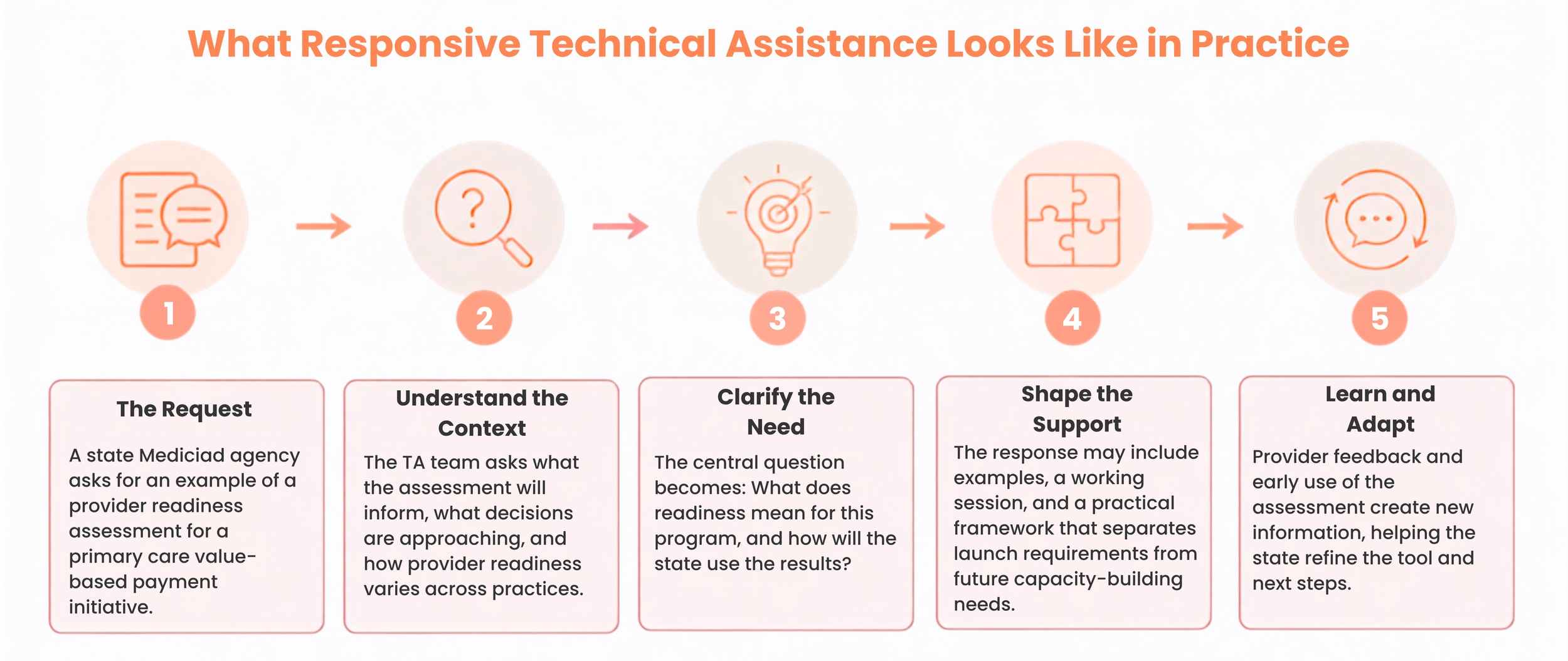
The process begins with listening and learning. Participant requests are one important source of information, alongside program data, stakeholder feedback, policy requirements, and what the TA team is observing as the work unfolds.
Together, those inputs help the TA team understand what is getting in the way. The right response may be a practical resource, a peer connection, a working session, or a quick answer that helps the participant keep moving.
Just as importantly, the process does not end when the support is delivered. Implementation creates new information. A provider conversation may reveal an assumption that needs to be reconsidered. Early experience may show that a process works differently across organizations. A change elsewhere in the program may alter what needs attention next.
Those lessons feed back into the process, and the support adapts as the work becomes more real.
Back to the Readiness Assessment
So what happens with the state Medicaid agency that asked for an example?
The TA team still shares relevant readiness assessments. But instead of beginning by adapting one, the team first works with the state to clarify what the assessment needs to accomplish.
Through that discussion, the agency distinguishes between capabilities providers truly need before participating and areas where additional support could help practices develop over time. It also becomes clearer how assessment results will be used, which makes it easier to determine what information is worth collecting.
Now the examples serve a different purpose. Rather than offering a template to copy, they give the state concrete approaches to consider as it develops something suited to its own program.
The resulting assessment may be shorter than the state initially imagined. It is also more useful because each question connects to a decision the agency is prepared to make or a form of support it can provide. When providers begin reacting to the tool, their feedback becomes another input that can help the state refine its approach.
By the time the state returns to the original request, the question has changed. The team is no longer looking for a readiness assessment to borrow. It is defining what readiness needs to mean for this model and what the state will do with the information it collects.
Helping Implementation Move Forward
The difference may seem subtle, but it is central to how we think about quality technical assistance.
TA is not valuable simply because a resource was delivered or a question was answered quickly. Its value comes from helping participants work through the uncertainty that accompanies implementation and translating expertise into something that works in their environment.
Responsive TA also requires knowing when not to overcomplicate the work. Not every request has a deeper problem hiding beneath it, and not every question needs a facilitated process. Sometimes a state needs an example, a quick answer, or another set of hands to move an urgent task across the finish line. Quality TA means being able to tell the difference.
The best TA meets the moment. It helps participants get clear on what they need and keeps implementation moving.
That is the kind of TA we try to build at Coral: thoughtful, practical, and focused on making hard work easier to move through. If your organization is navigating a complex implementation challenge, connect with Coral Health Advisors to explore how responsive, practical technical assistance can help move the work forward.