
Health Care Matters | January 16
ACA Enrollment Drop
Initial enrollment figures for 2026 ACA marketplace coverage show a significant decline, with 22.8 million Americans signed up through January 3, down 1.4 million from the final 2025 enrollment period. The drop comes as premiums have roughly doubled following the December expiration of enhanced subsidies that were first enacted during the COVID pandemic. However, experts caution these numbers don't tell the complete story: enrollment continues through January 15, and several state-based exchanges have extended their deadlines to January 31. More importantly, many consumers whose policies were auto-renewed may drop coverage once they receive their first bills showing the steep price increases. Read more here, here, and here.
Why It Matters
These preliminary figures align with projections about the impact of subsidy expiration, though the full picture won't emerge until consumers receive their first bills over the next 2-3 months. The Congressional Budget Office estimates 2 million additional uninsured Americans this year, while some analysts expect losses of several million once auto-renewals unwind. The Trump administration attributes much of the decline to anti-fraud measures and tightened eligibility checks, but the timing strongly suggests premium increases are the primary driver.
The political stalemate continues as the White House released the “Great American Health Plan,” a high-level policy framework and messaging document rather than an enacted coverage proposal, even as Congress remains deadlocked on extending enhanced subsidies. The House passed a clean three-year extension, the Senate rejected it, and President Trump has signaled he may veto any bill that reaches his desk. Without congressional action, millions of Americans will face a choice between paying doubled premiums or going uninsured until next year's open enrollment period.
UnitedHealth Used Aggressive Tactics to Boost Medicare Payments, Senate Report Finds
A new Senate Judiciary Committee report alleges that UnitedHealth Group has deployed aggressive tactics to maximize Medicare Advantage payments through risk adjustment. The investigation examined over 50,000 pages of documents and found that the company maintains a robust workforce dedicated to capturing payment-boosting diagnoses through home health risk assessments and leverages sophisticated data and AI infrastructure to identify coding opportunities. The report concludes that UnitedHealth has "turned risk adjustment into a major profit centered strategy, which was not the original intent of the program," and that other Medicare Advantage organizations contract with UnitedHealth to gain similar coding insights. UnitedHealth disputes the findings and maintains it complies with CMS regulations. Read more here and here.
Why It Matters
This report lands as the Trump administration and CMS are actively examining Medicare Advantage program reforms, including a recent Request for Information seeking improvements to the program's integrity and sustainability. Given mounting concerns about MA overpayments and the administration's focus on reducing health care costs, we expect continued and potentially heightened regulatory scrutiny of risk adjustment practices across the industry. UnitedHealth's dominant market position and sophisticated coding infrastructure make it both a primary target for enforcement and a bellwether for broader industry changes. The market is already showing signs of stress with some payers exiting MA markets, as margins have already tightened industry-wide. If CMS pursues stricter auditing, revised risk adjustment methodologies, or new compliance requirements in response to these findings, these trends will likely accelerate. The result could be further consolidation as smaller players without UnitedHealth's scale and data capabilities find it increasingly difficult to compete, and the entire sector forced to reexamine practices that have driven profitability for years.
Look for the Helpers: New Orleans Community Center Offers Lifeline Through Mutual Aid
The Fred Hampton Free Store, operating out of an abandoned Family Dollar in New Orleans' Lower 9th Ward, has become a vital lifeline for vulnerable residents by offering free clothing, medications, and essential supplies, all donated by community members, alongside weekly health services and harm reduction programs. Dan Bingler, who founded the Greater New Orleans Caring Collective and runs the space, partners with volunteers who provide free medical care, wound treatment, and help connect people to resources like transportation and addiction treatment. This grassroots effort exemplifies how dedicated individuals create positive change through compassion and service, with one former visitor crediting the volunteers who "cared for people who didn't have nobody to care for them" for helping him achieve recovery after decades of drug use. Read here.

What We're Writing
CMS Announces the First Year of Rural Health Transformation Program Funding: What the FY26 Awards Show
CMS’s announcement of the first year of Rural Health Transformation Program awards underscores how states are directing funding toward shared priorities like workforce development, telehealth enhancement, chronic disease prevention, and infrastructure modernization. Coral’s blog examines emerging patterns from the FY26 awards and what those patterns suggest about where technical assistance and strategic focus may be most needed next. Read the full blog post here.
CMS Announces New ACO Initiative: What You Need to Know About the Long-Term Enhanced ACO Design (LEAD) Model
CMS has announced the LEAD Model, a new 10-year accountable care initiative launching in 2027 to replace ACO REACH, signaling a shift toward longer time horizons, more predictable benchmarks, and expanded pathways for smaller, rural, and specialized organizations. The post highlights what makes LEAD different from prior models and what prospective participants should be watching as applications open in March 2026. Read the full blog post here.
Updated Resource
Rural Health Transformation Program: State Initiative Tracker
We’ve released an updated version of our RHTP state tracker with new data and analysis. The tracker now reflects the most current and complete 50 state view and incorporates newly released award amounts, along with brief context on how funding has been distributed across states.
If you work with states, providers, or partners navigating RHTP opportunities, this tracker offers a clearer picture of where activity is happening and how resources are being allocated. Download here.
What We Are Reading
Setting Realistic Expectations for Advanced Primary Care Success
Morgan Health's new report advises employers that advanced primary care requires long-term commitment to realize cost savings and health improvements, recommending they track early indicators like engagement rates, preventive screenings, and reduced ER visits rather than expecting immediate financial returns. Read here.
Multidimensional Approaches to Ranking State-Level Rurality to Enhance Comparisons Across States
A new Milbank Quarterly study introduces a multidimensional rurality index combining population share, land area, and density to help policymakers and researchers make more accurate state comparisons and develop targeted rural health policies beyond traditional single-indicator measures. Read here.
Millions Of Women Don’t Have Access To Maternity Care - And The Number Is Growing
Authors of a new Health Affairs Forefront article warn that obstetric unit closures will likely continue without targeted efforts to address maternity care financing, as more than 5.8 million reproductive-age women already lived in counties without hospital-based childbirth care in 2023, up 1.5 million since 2010. Read here.
What We're Attending
LEAD Model Overview Webinar
CMS will host an overview webinar on the LEAD (Long-term Enhancing ACO Design) Model, covering model goals, participation and eligibility, payment methodology, and the application timeline and process.
LEAD builds on prior Innovation Center accountable care models and introduces updated benchmarking intended to support a broader range of providers, including those new to ACOs and those serving complex or high-needs populations. With a 10-year performance period, LEAD is designed to support long-term sustainability, coordinated care for high-needs beneficiaries, and durable savings. Register here.
Pop Health Podcast
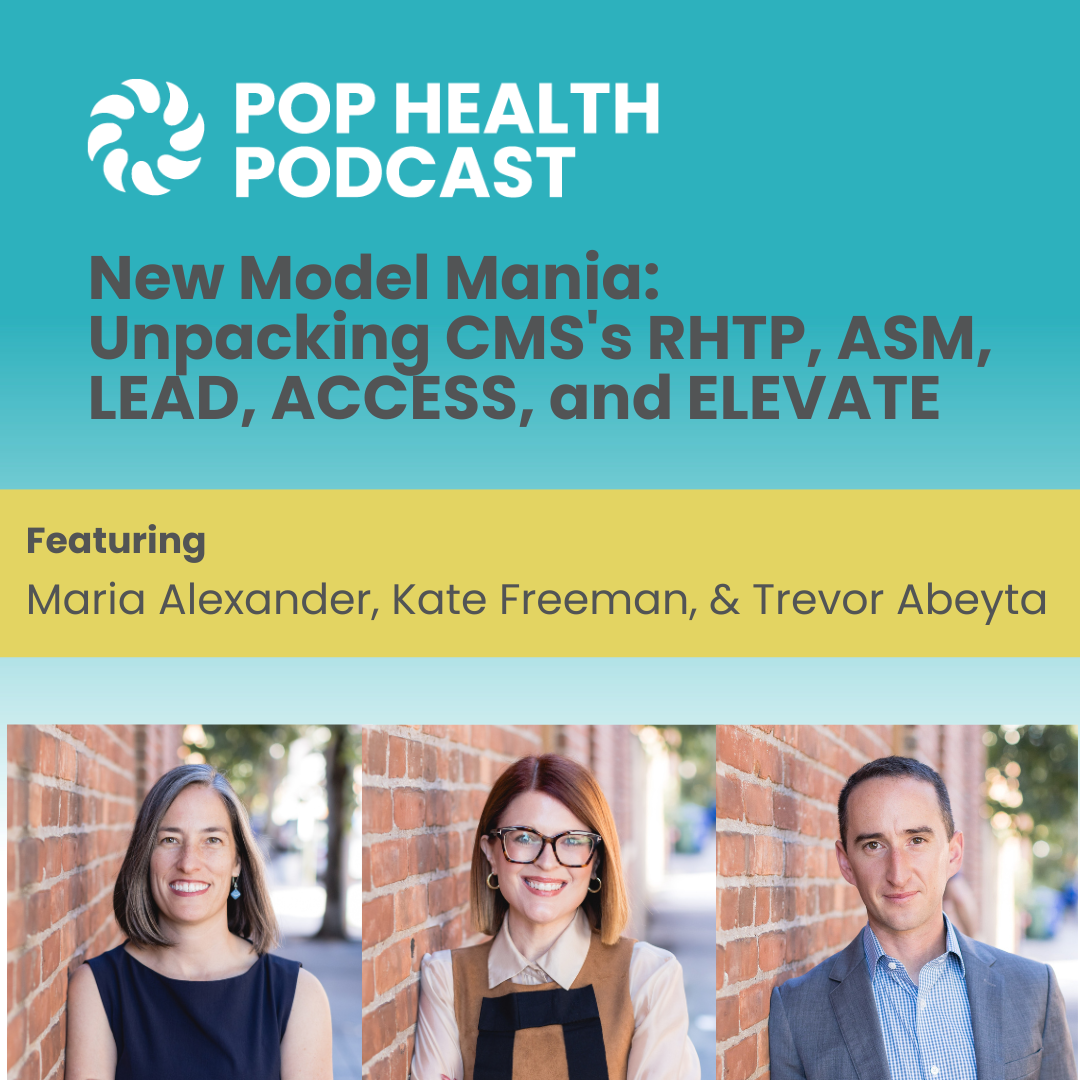
New Model Mania: Unpacking CMS's RHTP, ASM, LEAD, ACCESS, and ELEVATE
In the latest episode of the Pop Health Podcast, we break down CMS’s expanding portfolio of payment and delivery reform models, from the Rural Health Transformation Program and the Ambulatory Specialty Model to the new LEAD and ACCESS initiatives and the emerging ELEVATE framework, and discuss what these shifts mean for providers, payers, and health care leaders navigating value-based care in 2026 and beyond.